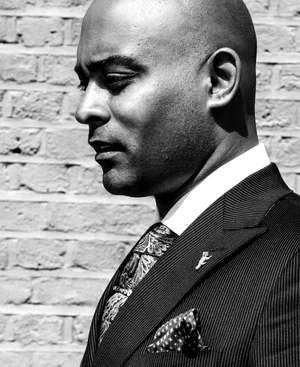
What Does A Bespoke Tailor Do For Busy Professionals?
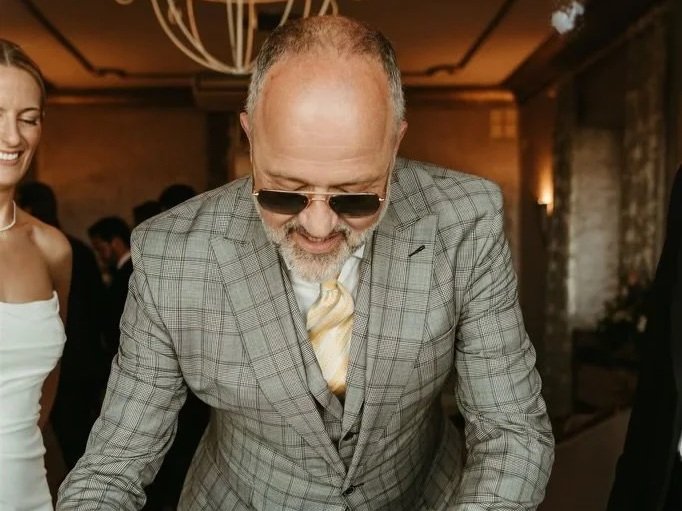
I turned up to see my client and friend Patrick Shields to fit his new bespoke suits the other week and, within about thirty seconds, realised I was going to have to shut the hell up.
Which, as those of you who know me reasonably well will appreciate, isn’t necessarily one of my core skills.
As Head of Surety at Howden CAP, Patrick is a very busy man, and when I arrived for his appointment, he was in the middle of a fairly major call with what sounded like his boss in the States, which clearly wasn’t going to finish anytime soon.
Now I suppose there were a few ways we could have dealt with this.
We could have abandoned the fitting and rearranged it, which would have meant finding another space in Patrick’s diary and mine. He could have tried to hurry the call along because I was standing there waiting for him, which would have been ridiculous given that whatever was happening on the phone was clearly more important at that moment. Or I could simply work around him.
I was there. Patrick was there. I’ve been making clothes for him for more than twenty years; I knew exactly what I needed to do, and there seemed absolutely no reason why either of us should have to rearrange our days because something unexpected had happened.
So we did the fitting in silence. And when I say silence, I mean it.
I unpacked everything, Patrick carried on with his call, I indicated when I needed him to stand up, turn around or move slightly, he somehow understood whatever ridiculous combination of pointing, nodding and hand gestures I was using, and I got on with fitting his clothes while he got on with running his business.
Every now and again we’d make eye contact, there’d be a little nod to confirm we both knew what was happening, and at one point I found myself holding his phone in front of his face while checking his sleeve lengths so he could continue talking.
Not something they necessarily teach you when you’re learning to become a bespoke tailor, but it worked.
Immediately afterwards I started thinking about why it worked, because although it was an unusual fitting, it didn’t actually feel particularly unusual to either of us.
What Does Personal Bespoke Tailoring Actually Mean?
I’ve worked with Patrick for more than twenty years, so I know him, I know his clothes, I know how he likes things to fit, and I knew what needed to happen during that appointment.
When his circumstances suddenly changed, I didn’t need him to stop what he was doing and start looking after me.
Actually, writing that sentence makes me think that might be the important bit.
I didn’t need him to look after me.
And I wonder whether businesses sometimes get the idea of personal service slightly backwards, particularly at the luxury end of the market.
We talk about private appointments, beautiful surroundings, coffee, champagne, expensive packaging and all the other things that are supposed to make something feel luxurious, and there’s absolutely nothing wrong with any of those things, but I’m not convinced they’re what makes a service genuinely personal.
For me, personal service is knowing somebody well enough to make their life easier.
Sometimes that means changing what you’re doing in the moment because their day hasn’t gone according to plan.
A Bespoke Tailor Has To Fit Around Your Real Life
Most of the men I work with in London have incredibly busy lives, and I know that because I see them happen around me all the time.
Phones ring during fittings. Meetings overrun. Flights get moved. Somebody suddenly needs to be somewhere else. An appointment slot that looked perfectly fine when we put it in the diary two weeks ago can become considerably less okay by the time I walk through the door.
That’s normal.
These are senior lawyers, entrepreneurs, partners, executives, people working in finance and property and all sorts of other businesses where the day they thought was going to happen isn’t necessarily the day they’re having by mid-morning.
I think this is where the relationship with a bespoke tailor can become much more useful than simply having somebody who makes you a nice suit. Because I can either become another thing you have to manage, or I can learn to work around you.
I know which one I’d rather be.
It’s one of the reasons I’ve never been particularly interested in putting every client into the same system. Different people need different things from me and, actually, the same person can need different things from me depending on what’s happening in his life that particular week.
Patrick’s fitting is probably quite an extreme example of that, but the principle behind it is completely normal.
The Longer I Know You, The Less You Should Have To Explain
There’s another side to bespoke tailoring which I think gets overlooked because we spend so much time talking about the clothes themselves.
Obviously I need to know your measurements.
I need to understand your body, posture and proportions. I need to know how you like your trousers to sit, how much shape you want through a jacket, how you feel about the length of your shirts and a hundred other details that gradually become part of your personal patterns.
But over time I learn much more than that. I learn which jackets you actually reach for rather than the ones you theoretically like. I learn what colours you feel good in, whether you’ll tolerate something that needs pressing every five minutes, what you tend to wear when you go out for dinner, whether you spend half your life getting on and off aeroplanes and how formal your working life really is rather than how formal somebody might assume it is from your job title.
I know the client who wants to experiment and the client who would rather I didn’t suddenly decide this is the season we’re all wearing orange. I know who loves clothes and wants to spend an hour talking about them and who would be perfectly delighted if his entire wardrobe could somehow organise itself without his involvement.
None of those things sounds enormously significant individually, but after five, ten or twenty years they add up to something quite valuable.
I know you.
And that means the amount of work you need to do gradually decreases.
Bespoke Tailoring Can Become Wardrobe Management
This is probably where my idea of what a bespoke tailor should be has changed over the years.
I still love making clothes. Of course I do - I’m a tailor!
But I’m increasingly interested in everything that happens around those clothes because that’s often where I can make the biggest difference to somebody’s life.
You’ve got a business trip coming up and need to work out what to take, or you’ve been invited to something and have no idea what the dress code means.
Your working environment has become less formal, and suddenly the twenty suits hanging in your wardrobe aren’t solving Tuesday morning anymore.
You’ve got a wedding, Wimbledon, a black-tie dinner, an important presentation or three days of meetings somewhere horribly hot, and you need to know that when you open your wardrobe, everything required is already sitting there.
Or perhaps nothing particularly dramatic is happening at all. You’re just very busy and don’t want to spend Saturday wandering around shops trying to solve clothing problems.
Once I know you properly, those things can increasingly become my problem rather than yours.
You tell me what’s happening. I work out what you need. We identify what you already have, what’s missing and what we should be adding next, and gradually your wardrobe starts being built around the life you actually live rather than becoming a collection of things bought reactively because something appeared in the diary.
I quite like the idea of becoming almost invisible in that respect, a sort of wardrobe ghost, although having written that down I’m not entirely sure “ghost tailor” is the luxury branding direction my wife Carolina has been waiting all these years for me to discover.
But you know what I mean, right?
Someone who knows you well enough to quietly sort this part of your life out without constantly demanding your attention in order to do it.
Why A Long-Term Relationship With Your Tailor Matters
I think that’s where the real value of a long-term relationship with a bespoke tailor lies, and perhaps I’ve never articulated it properly before because when you’re the person doing these things every day, they don’t necessarily seem remarkable.
Of course there’s consistency of fit. Once we’ve developed your patterns, we’re not starting from scratch every time you want another pair of trousers, shirt, jacket or suit.
But there’s also consistency of understanding.
I know what we made last year. I know why we made it. I know what we’re trying to build towards, and I can help make sure the next thing we add works with everything else rather than becoming another isolated purchase hanging in the wardrobe.
And when life changes, the wardrobe can change with it.
You get promoted. You change industries. You start travelling more. Your office becomes more casual. You lose weight, gain weight, get older, start entertaining differently or simply decide the way you dressed ten years ago doesn’t feel particularly like you anymore.
That’s normal too.
A good tailoring relationship should evolve with you, rather than repeatedly trying to fit you back into the same clothes. Which brings me back to Patrick.
Patrick needed to take his call, and I needed to fit his clothes, so we found a way of doing both. No drama, no rearranging diaries and no making an already busy man’s day slightly more complicated because his tailor happened to be standing in front of him.
His call finished just as I was packing everything away and Patrick, being Patrick, immediately wanted to spend the time we’d lost together catching up, but I already knew his schedule and knew he needed to go straight into his next meeting.
So I walked him halfway there, and we caught up as we went, and somewhere along the way I told him about Emily passing away because he’d known her since she was a puppy.
He got upset. I started tearing up. We ended up hugging each other in the middle of his trading floor, which probably wasn’t how either of us imagined this particular fitting ending when I’d arrived half an hour earlier, and then I sent him off to his next commitment.
And perhaps that tells you something else about what happens when somebody has been your client for more than twenty years.
It stopped being simply about the clothes a very long time ago.
If Your Wardrobe Is Taking Up More Of Your Time Than It Should
If you’re reading this because you’re looking for a bespoke tailor in London, I’d probably start by asking you the same sort of questions I ask every new client.
Not simply: what suit do you want?
I want to know what your life actually looks like.
What do you do during the week? Where do you go? Who do you see? How often do you travel? What do you wear outside work? Where does your existing wardrobe keep letting you down and, perhaps most importantly, how much time and thought do you actually want to devote to clothes?
Because if the answer to that last question is “as little as possible, Roberto”, that’s completely fine.
You get on with your life.
I’ll deal with the clothes.