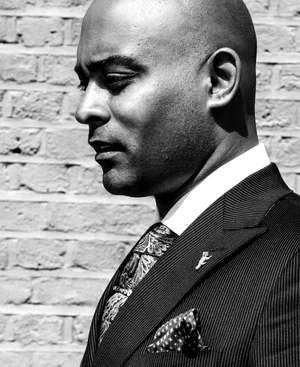
The Suit Is Back. And This Time It Means Business.
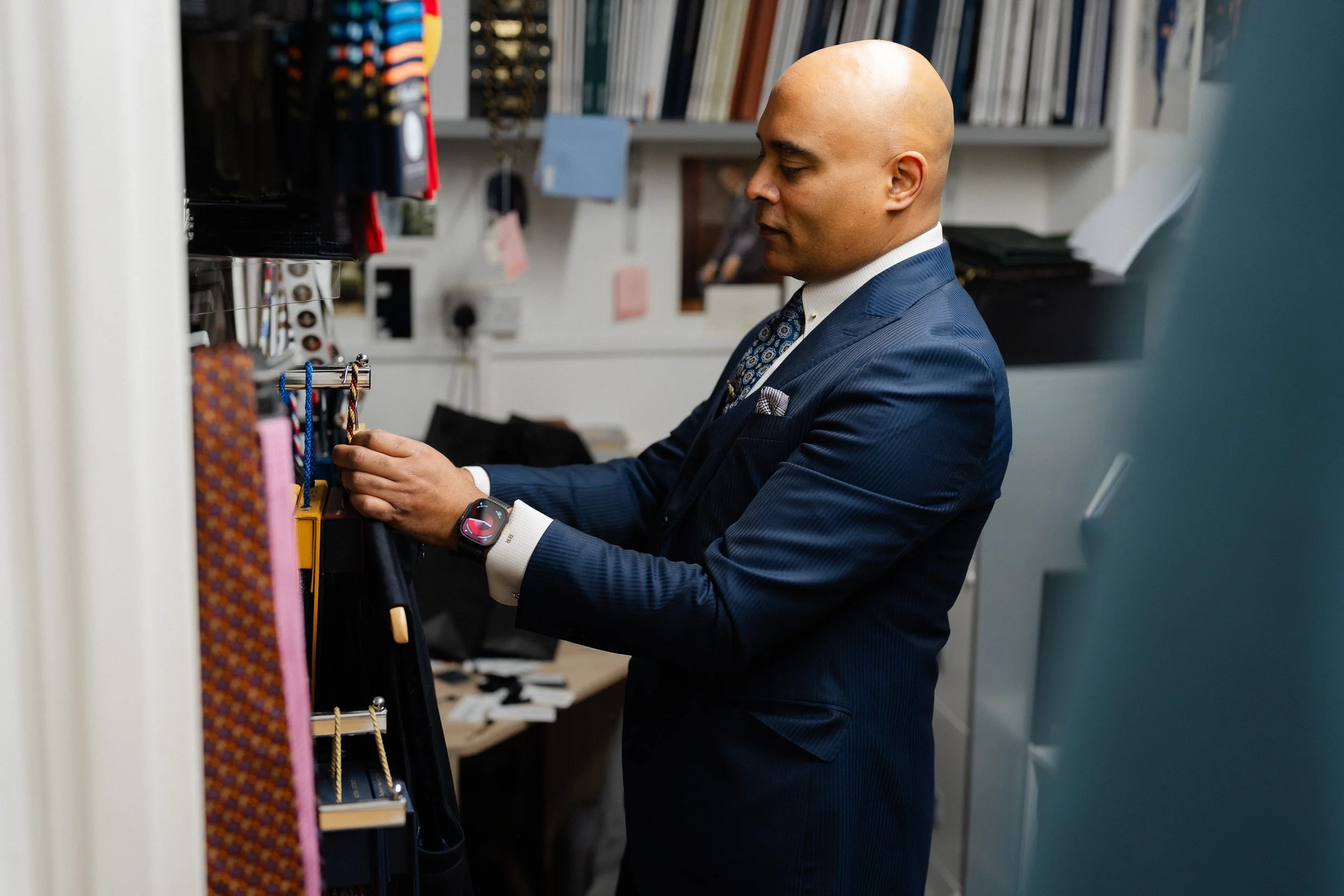
There’s a particular kind of conversation I’ve been having a lot recently and it goes something like this: a client walks in to the workroom, we sit down and before I’ve even offered him a coffee he says something along the lines of “We’re looking at suits today, I’m done with casual.” Sometimes it’s a quiet statement, like a man who’s made up his mind after a long internal argument with himself. Sometimes it’s almost exasperated, like he’s been waiting for permission and he’s finally giving it to himself. Either way, the energy in the room is unmistakable, and after twenty-three-odd years of doing this, I’ve learned to trust that energy because it tells me more about where we are right now than any trend report or fashion article ever could.
The workroom doesn’t lie - and right now we are busy in a very specific way. It’s not just the volume of work, it’s the type of work. We are still making a lot of smart casual jackets, trousers, jeans and casual shirts. But also suits… proper suits. Occasion-worthy suits and wedding suits, yes, but also working suits, everyday suits, suits for men who’ve looked at their wardrobes and thought, right, enough of “smart casual”, I want to look like I mean business. Some clients are coming back to suits after years away from them. Some are even putting on a tie for the first time since, honestly, probably about 2015. And some clients are younger than you might expect, sharper than you might assume, but absolutely clear on why they want what they want.
The Cycle I’ve Seen Before (and Before That, and Before That)
The thing with this industry over a long career is that you start to see the same patterns repeating themselves, and you’d be a bit mad not to take note. When times are good, really good, people start to relax. They get comfortable, and a little complacent and the dressing follows suit, (couldn’t resist that pun!). Casual creep sets in, dress standards drop a level or five. Then the economic outlook turns toward uncertainty and something interesting happens: people - on average - start to dress up again.
Sometimes it’s about looking competitive. If there are redundancy conversations happening in your industry, you don’t want to be the person who looks like they don’t care and have too much free non-client non-business generating time on their hands. And sometimes it’s simply more proactive than that, it’s about signalling to a room full of peers, clients, or senior stakeholders that YOU are the one who’s switched on, prepared and taking everything seriously. Either way, the instinct is the same: when waters get choppy, the standards change upward.
We’re kind of living through one of those moments right now. The economic uncertainty and turbulence we’re all dealing with, the shift in employment dynamic from the pandemic era when employees seemed to hold the power, to the present day with firms asking staff back into offices four and even five days a week AND expecting professional standards to return with them. All of this is feeding a very real shift in how men are thinking about how they present themselves. The most ambitious, most self-aware men I know are thinking carefully about how they’re being perceived by peers, by superiors and by clients they haven’t even met yet. And a number of them have landed on the same conclusion: smart casual, for all its apparent flexibility, leaves too many potholes. Especially on a day where you might meet a mix of people, or you just aren’t sure what the day’s going to throw at you. A suit, they’ve decided, is just the foolproof option. And I totally agree - not because I’m a tailor and making more suits is in my interest (see note above re the amount of custom smart casual clothing we produce), but dressing up and looking my best was a part of my psyche even before I got my break in tailoring, when I worked in the worlds of retail and tech.
What My Clients Are Actually Telling Me
The conversations in the fitting room are completely honest ones, because that’s the just the nature of the relationship I build with my clients. And what I’m hearing right now is a range of motivations that all point in the same direction. Some clients have decided, quite deliberately, that they want to reflect their position (or the position they want to be in). The authority, the experience, the perceived status they’ve earned. They’ve been dressing down for a few years because culture said they could, but they’re now looking around and thinking, “Actually, I’m a senior person, I should look like a senior person”. Others are just exhausted by the endless decisions that casual dressing requires. Dress down sounds simple (and for some people it is, I see people walking around like they got dressed blindfolded and grabbed whatever was immediately to hand), but the sheer cognitive load of figuring out what “smart casual” even means on any given day is totally underrated as a source of low-level stress.
And then there are my younger clients, the ones who are perhaps the most interesting to me right now. They’re ambitious, they’re sharp and they’ve spotted something that the generation above them perhaps missed. In an office full of men wearing varying degrees of smart-casual, a well-groomed man in a well-made suit stands out. Not in an aggressive or try-hard way, but in the way that competence and intention will always stand out when surrounded by seeming indifference. They want to look ready - for anything, for anyone… ready to be taken seriously. And they’re absolutely right to want that.
Paris, the Runways and What Actually Filters Down
The provisional calendar for Paris Men’s Fashion Week SS27 is shaping up to be a proper statement season, telling stories around sharp dressing that’s built to last, investment pieces, coats and tailoring construction as the central tale rather than merely a supporting act. Several editorial voices this week have been declaring something like a new rulebook for office dressing in 2026, naming soft tailoring, reading the room and the resurgence of garments like the unstructured blazer as the key moves for the year. Now, I always say take runway commentary with a degree of measured scepticism because the distance between what walks down a catwalk in Paris and what actually works in a real man’s working life is a long road. But the direction of travel matters and right now, every signal from the fashion world is pointing the same way as what I’m seeing in my workroom. That convergence is significant.
Investment dressing is the phrase of the moment and it’s the totally right one. Not trend dressing or statement dressing. Investment dressing. The idea that you’re buying something that’s considered and long-lasting, not buying into a fashion moment that’ll feel embarrassing in a year or two’s time. That, of course, is what bespoke tailoring has always been about.
The Watch Conversation, and Why It Keeps Coming Up
I’ll be upfront here: I don’t know enough about the uber-expensive end of the watch auction world to speak with any authority about it. But when I heard that a Patek Philippe Reference 2499 First Series just sold for over ten million US dollars at Phillips Hong Kong, making it the most valuable watch ever sold at auction in Asia, with Christie’s Hong Kong setting their own records in the same sale period including an F.P. Journe Black Label, it tells me that there’s a very real micro-economy of the uber-wealthy for who that level of indulgence is simply available to them. Fine. That’s a different world to the one most of us move in.
But what interests me more is what’s happening at what I’d loosely call the everyday luxury end, and I use the word loosely because Rolexes aren’t cheap by any means, as we all know. I’ve started wearing my twenty-year-old Omega Seamaster again. I’d been wearing my Apple Watch in it’s various iterations and upgrades every single day for over a decade, barely thinking about it and then something changed recently. I just picked up the Seamaster one morning because I need to photograph it for an article I was writing for the Tailoring Talk Magazine podcast, and I haven’t looked back. I think a lot of men are having a version of that conversation with themselves right now. Digital fatigue is real. The wider digital detox movement, the desire to not be quite so permanently connected, is sparking a genuinely renewed interest in mechanical watches. And there’s something worth saying here: a smartly dressed man wearing a quality watch, whether that’s a Tag, an IWC, an Omega, a Rolex, or something from that world, looks infinitely more considered and successful than the same guy with a smartwatch strapped to his wrist. That’s not snobbery, it’s just what a certain kind of personal presentation can say about a person and the impression they make.
There’s also the UK tax angle, and it’s one that constantly crops up in client conversations. With inheritance tax changes and the direction of current government policy, there’s a growing interest in holding value in tangible things. Art, watches, classic cars… things that can be handed on, literally passed to children or grandchildren. Rolex has just adjusted its June 2026 pricing, moving gold models up while keeping steel flat, which shows a brand managing its positioning very deliberately, metal by metal. None of this is accidental.
What Luxury Actually Means in 2026
The Hurun Chinese Luxury Consumer Survey for 2026 paints a picture that I think resonates well beyond its quite specific focus. Among ultra-high-net-worth consumers, the shift is away from objects and toward experiences, but not in a way that dismisses the object entirely. What it says is that the story and the service around the product now matters as much as, if not more than, the product itself. The Kearney 2026 luxury outlook repeats this, noting that while growth is uneven across the luxury sector, UHNW and HNW consumers remain the most stable and committed luxury spenders. They’re not pulling back - they’re just expecting (and demanding) more.
That’s consistent with something I’ve believed for a long time. Bespoke tailoring was never just about the suit. It was always about the relationship, the conversation, the process of building something together that genuinely fits you, your life, your ambitions, how you want to be seen and how you want to feel. You can see echoes of that same desire for something personalised and meaningful in what the Orient Express Corinthian, their new sailing yacht, began doing this June with its maiden Mediterranean voyage, or in what Hermès is communicating by opening a new leather goods workshop in France. These are brands investing in craft and heritage as their primary story, which is something that tailoring has always understood.
(And yes, even Bottega Veneta’s new mushroom-derived intrecciato leather goods and Bugatti’s planned V-16 hybrid hypercar debut speak to the same appetite for the exceptional and the considered, even if those are slightly further from my wheelhouse than a beautifully hand sewn Neapolitan shoulder.)
The Thing That Was Never Really a Trend
So after twenty-three years and more client conversations than I could possibly count, I’ve learned that tailoring has always had cycles of popularity in broader culture. It gets pronounced dead and then it gets called back into service with great fanfare. But the men who’ve been my clients throughout all those years, the ones who kept coming back regardless of what culture and society were doing, they never thought of it as a trend. They thought of it as the right thing, the considered thing. The thing that repaid their investment in confidence, presence and simply feeling properly dressed.
What’s happening right now with the suit isn’t a trend coming back. It’s something much more fundamental. It’s men deciding, in the context of potential economic pressure and a genuine reassessment of how they want to show up ion the world, that the suit is the serious option. And they’re right - it always has been.
If you’re thinking about your wardrobe and what it’s saying about you right now, I’d genuinely love to have the conversation. Get in touch through the website or find me on the usual channels. It’s the kind of chat I find endlessly interesting, and I don’t think you’ll regret having it.
Roberto Revilla is a bespoke tailor based in London with over 23 years in the industry. He is also co-host of the Tailoring Talk Magazine podcast.