Should Suit Trousers Be Slim or Straight?
This is one of those questions where people want a nice neat answer, and the truth is there just isn’t one.
Should suit trousers be slim or straight?
Well, it depends. It depends on multiple things, and as a bespoke tailor the very first things I’m thinking about are the build, shape and height of the client. I’m not starting with a trend report or whatever menswear has decided is fashionable this week. I’m starting with the man standing in front of me, because that’s where the answer always is.
That’s one of the problems with modern menswear actually. Too many people are trying to answer questions like this as if there’s one universal rule and there really isn’t. The right trouser shape for one man can be completely wrong for another, and when you get it wrong the whole thing can feel a bit off even if the suit itself is technically quite nice.
For me, tailoring is always about balance and putting my client in the best possible light. That’s the job. Not to make him look fashion led. Not to make him look like he’s trying to prove something. Not to squeeze him into whatever shape happens to be in. Just to make him look right. Comfortable, confident, capable, well balanced, and like he belongs exactly where he is.
That’s what most serious men actually want from their clothes whether they realise it or not. They want to get dressed and then forget about it. They don’t want anything niggling away in the background, nothing pulling, nothing pinching, nothing making them feel self-conscious, nothing making them wonder if they look a bit ridiculous. They want to put their clothes on, go about their day’s business, and know they look their absolute best without having to think about it again.
That’s why this question matters more than it might seem.
When men ask whether suit trousers should be slim or straight, what they’re often really asking is how do I avoid getting this wrong? How do I make sure I look sharp, serious, balanced and put together? How do I avoid walking into a room and looking like I’ve misjudged myself?
Because that’s usually the fear underneath it all. Not being taken seriously. Looking less competent than they are. Looking like they don’t quite belong in the room. For a lot of the men I meet, especially successful men and UHNW men, there’s usually a strong preference for understatement as well. Some like a bit of wow factor sure, but it’s usually understated wow rather than full peacock. They want to look impressive without looking like they’ve tried to be impressive.
And that’s why moderation so often wins.
Now, when trousers are too slim, what goes wrong depends on what I’m looking at. If you’ve got a bigger overweight man in trousers that are too slim through the leg, he can look really unbalanced. If his legs are large it can look as though they’ve been stuffed into the trousers. On the other hand if his legs are quite slim in relation to the rest of him, he can end up looking like a big Christmas bauble balanced on toothpicks. Neither is doing him any favours.
Likewise, if you put a short man into trousers that are too wide, suddenly his legs look shorter than they really are and the whole thing starts working against him. So again, there’s no point saying slim is right or straight is right without first looking at the man himself, because the answer only makes sense in relation to his build.
That’s why in tailoring everything comes back to balance.
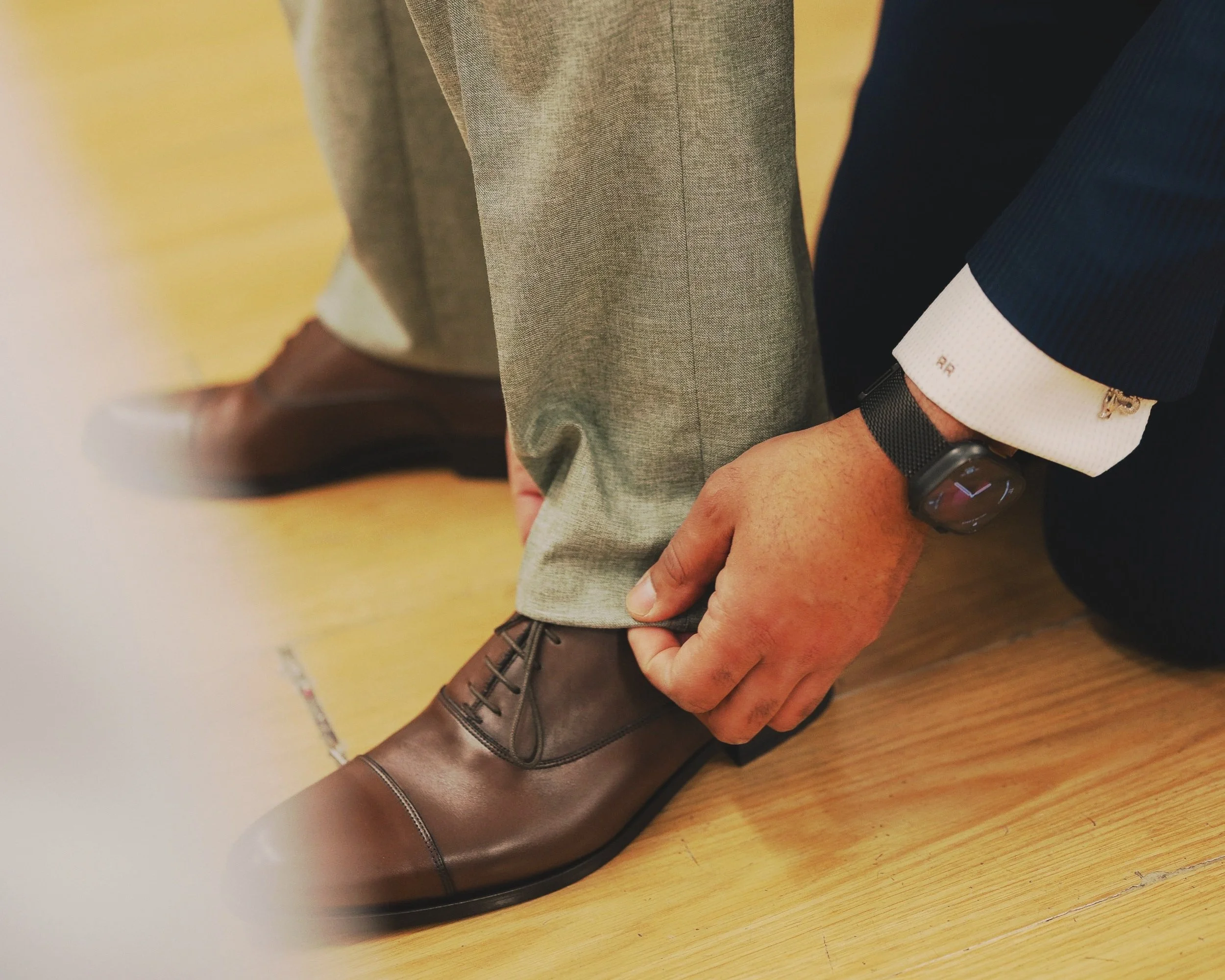
When I’m looking at a trouser line, I want it to fall cleanly and fluently. From the side, it should drop from the seat through the thigh to the hem in a smooth line, and it needs to stay in proportion through the knee. From the front, I’m always looking at the client’s knees in relation to each other. If he’s knock-kneed or bow legged, I want to take that into account and adjust the fall from the side of the waistband at the hips so that visually he looks balanced and even. The whole point is that there are no odd twists, no ugly breaks, nothing fighting the body. Even if underneath his actual body is a bit all over the place, visually I want the finished result to look calm, clean and right.
That’s a huge part of what good bespoke should be doing, and it’s one of the reasons so many men end up disappointed elsewhere. A lot of tailors, in my experience, just copy and paste. They’re not really thinking carefully enough about the individual in front of them. They’ve got a way they cut, a way they like things to look, and they more or less push everybody through the same filter. From what I’ve seen generally, a lot of people aren’t making the correct adjustments for each and every individual.
That’s one of the reasons everything we do takes a little longer. I don’t like to rush the patterning process. There’s a one to two week gap between a client placing an order and the clothes going into production because I want the time to think properly. I want to assess what I’m seeing, work through it, and make sure the pattern is doing what it needs to do. That time matters. It’s part of why the end result works.
Then of course there’s the off-the-peg issue, which is where a lot of men get this wrong as well. Certain brands and their cuts just won’t work for certain bodies, and most men don’t have the knowledge, inclination, or more often the time and patience to keep shopping around, trying different things on, and working out what really suits them. They just hit and hope, and wardrobes end up full of things that are sort of fine but not really right.
That can get expensive quite quickly.
At the same time, I don’t think the answer is to swing wildly in the other direction just because fashion has. In recent years, fashion pushed trouser widths very wide. Now, I understand one of the benefits, I had to buy a pair of wide leg jeans for a 70s themed party and honestly they were unbelievably comfortable, so I do get the appeal. But in a business setting, or when we’re talking about a successful person who wants to be taken seriously, it’s not really an appropriate look. Wider leg trousers can look great in the appropriate setting, when you’re not seeing anyone important, but generally speaking I think a moderate cut works best for most men.
That’s really my view on it. If you want to be taken seriously, moderation in dress is usually best. A man should look like he’s always dressed a certain way for most of his life. He can absolutely be influenced or inspired by fashion, but he shouldn’t be dictated by it. That’s a very different thing.
Now of course there are always exceptions. There are clients who, no matter what I advise, simply like their trousers to fit a certain way and that’s that. Fine. It’s their suit. But if a client isn’t insisting on being fashion led and just wants me to put him in the best possible light, then as a general rule I’m looking to create a moderate cut on the leg.
A useful rule of thumb from the cutting side is to take the seat circumference, divide it by two, then subtract 2 inches for the knee circumference and a further 2.5 to 3 inches for the hem circumference depending on the size of the feet. So, for example, someone with a 42 inch seat would end up with a 19 inch knee and around a 16 inch bottom width. That’s not me saying every man should have exactly that, because tailoring doesn’t work like that, but it gives you an idea of the sort of moderation I’m talking about.
Not too slim. Not too wide. Just right for him.
And really, that’s the answer to the whole thing.
If a client came to me and simply said, “So what should I choose then, slim or straight?”, I’d look at him for a second and instinctively tell him what was right for him. That’s how I work. I visualise the client in the correct outfit almost immediately, the colours, the cut, the style, the balance of it, and I work it out very quickly because the answer isn’t abstract. It depends on what is physically in front of me.
Some men suit a cleaner slimmer line. Some need a straighter line for better balance. Some need more room through the thigh and less emphasis lower down. Some need the hem adjusting depending on the size of their feet. Some need visual correction because of knock knees, bow legs, posture, stance or build. The right answer is always individual.
That’s what bespoke is supposed to be.
So should suit trousers be slim or straight?
Neither is automatically right. The best trouser shape is the one that makes the man look balanced, confident and comfortable, the one that flatters his build, supports the impression he wants to make, and allows him to walk into a room feeling like himself at his absolute best.
That’s really what most serious men are trying to achieve. They’re not trying to win at fashion. They’re trying to look like a man who knows who he is, knows what he’s about, and can be taken seriously without having to shout about it.
That’s where good tailoring starts.